Key takeaways
- Stelara (ustekinumab) is a prescription drug used to treat several autoimmune conditions, including plaque psoriasis and psoriatic arthritis.
- The prescribed dosage of Stelara may vary depending on the condition it’s being used to treat and your body weight. After two starting (loading) doses given 4 weeks apart, you’ll likely receive a dose every 8 or 12 weeks.
- Stelara can be given as an injection under the skin or an intravenous (IV) infusion (an injection under the skin given over a period of time).
Stelara is used in adults and children ages 6 years and older who have certain types of plaque psoriasis or psoriatic arthritis.
The active ingredient in Stelara is ustekinumab. Stelara belongs to a group of drugs called biologics. A biologic drug is made from living cells.
This article describes the dosages of Stelara, as well as its strengths and how to receive it.
Your dosage of Stelara will depend on several factors, including:
- the condition you are using Stelara for
- your body weight in kilograms (kg)
- your age
- other medical conditions that you may have
- the form of Stelara you receive
A doctor will determine the best dosage and form of Stelara for your individual needs.
Stelara forms
Stelara comes as a liquid solution in a single-dose prefilled syringe or a single-dose vial. The drug can be given two ways: as a subcutaneous injection (an injection under your skin) or as an intravenous (IV) infusion. With an IV infusion, you’ll get the medication through a vein over a period of time.
Stelara strengths
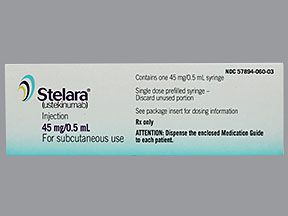
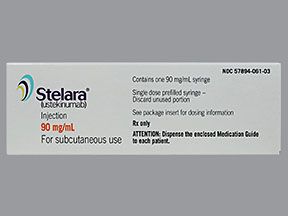
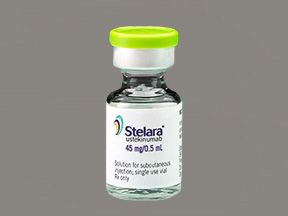
For subcutaneous injection, Stelara is available in a single-dose prefilled syringe or a single-dose vial.
The prefilled syringe and the vial come in a strength of 45 milligrams per 0.5 milliliters (45 mg/0.5 mL). In addition, the prefilled syringe is available in a strength of 90 mg/mL.
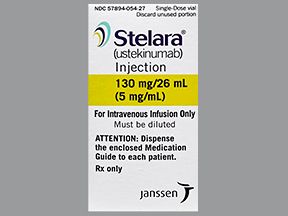
For IV infusion, Stelara comes in a single-dose vial that’s available in one strength: 130 mg/26 mL.
Stelara is approved to treat the following conditions:
The following information describes dosages that are commonly used or recommended. It’s essential to use the dosage prescribed by your doctor. They will determine the best one to fit your needs and preferences.
Dosage for plaque psoriasis
When used to treat plaque psoriasis, Stelara is administered by subcutaneous injection. The dosage of Stelara depends on your body weight as shown in the following table:
| Weight range | Starting (loading) dose | Maintenance dose |
|---|---|---|
| less than or equal to 100 kg (about 220 lb) | 45 mg, followed by another 45-mg dose 4 weeks later | 45 mg once every 12 weeks |
| greater than 100 kg | 90 mg, followed by another 90-mg dose 4 weeks later | 90 mg once every 12 weeks |
Dosage for psoriatic arthritis
When used to treat psoriatic arthritis, Stelara is administered by subcutaneous injection.
Regardless of your body weight, the starting dose of Stelara for psoriatic arthritis is 45 mg, followed by an additional 45-mg dose 4 weeks later. After these first two doses, you’ll get a maintenance dose of 45 mg once every 12 weeks.
If you’re an adult weighing more than 100 kg (about 220 lb) with psoriatic arthritis and moderate to severe plaque psoriasis, your dosage will differ. In this situation, the starting dose is 90 mg, with another 90-mg dose 4 weeks later. After that, you’ll get a maintenance dose of 90 mg once every 12 weeks.
Dosage for Crohn’s disease or ulcerative colitis
The recommended dosage for Crohn’s disease and ulcerative colitis also depends on body weight. When receiving Stelara for these conditions, you’ll receive your first dose through an IV infusion. This will help the medication work more quickly at the start of your treatment.
| Weight range | Starting (loading) dose |
|---|---|
| less than or equal to 55 kg (about 121 lb) | 260 mg (2 vials) |
| greater than 55 kg up to 85 kg (about 187 lb) | 390 mg (3 vials) |
| greater than 85 kg | 520 mg (4 vials) |
After your initial dose is given by IV infusion, you’ll switch to the subcutaneous form of the drug. The maintenance dosage is 90 mg every 8 weeks, regardless of your body weight.
Stelara is approved to treat plaque psoriasis or psoriatic arthritis in children ages 6 years and older. It’s not approved for use in children or adolescents with Crohn’s disease or ulcerative colitis.
The dosage of Stelara for treating plaque psoriasis or psoriatic arthritis in children is the same. The dosage is based on body weight, which will determine the initial dose. The same dose will be administered 4 weeks later and then every 12 weeks thereafter.
For children, Stelara is given as a subcutaneous injection as outlined in the following table:
| Weight range | Dose |
|---|---|
| less than 60 kg (about 132 lb) | 0.75mg/kg |
| 60 kg or more | 45 mg |
| greater than 100 kg (about 220 lb) with psoriatic arthritis and moderate to severe plaque psoriasis | 90 mg |
If your child weighs 60 kg or more, their dosage is the same as the dosage used in adults.
If you’re administering Stelara at home and you miss a dose, inject it as soon as you remember. But if it’s been a while since your missed dose, and you’re unsure when to get your next dose, you can ask your doctor or pharmacist. They can help you determine when your next dose should be.
If you need help remembering to take your Stelara dose on time, try using a medication reminder. This can include setting an alarm, downloading a reminder app, or setting a timer on your phone. A kitchen timer can work, too.
If you receive Stelara doses at your doctor’s office, it’s important to keep your appointments. If you miss an appointment, it’s important to call the office immediately to reschedule.
To help make sure you don’t miss your appointment, try setting a reminder on your phone.
Stelara comes as a liquid solution that can be given as a subcutaneous injection (an injection under your skin) or as an intravenous (IV) infusion. A healthcare professional will administer the IV infusion form of Stelara in a medical setting, such as a doctor’s office or clinic. The infusion will be administered over a minimum of 1 hour.
Most people taking Stelara receive it as a subcutaneous injection. Your doctor may be able to teach you or your caregiver how to administer Stelara injections, allowing you to self-inject your doses at home. If your child is receiving subcutaneous injections of Stelara, it’s recommended that a healthcare professional administer their doses.
You can inject Stelara into your upper arms, buttocks, upper thighs, or abdomen. If you receive Stelara at home, it’s important to rotate your injection sites. Rotating injection sites means to inject into an area that’s different from where you injected the last dose.
Do not inject Stelara into skin that is red or discolored, hard, tender, or bruised.
For more information about how to inject Stelara, see the manufacturer’s step-by-step instructions.
How long is the treatment with Stelara?
Stelara is typically used as a long-term treatment. If you and your doctor determine that Stelara is safe and effective for you, you’ll likely receive it long term.
If injecting Stelara at home, do not use more than your doctor prescribes. Doing so can lead to serious side effects.
Call your doctor right away if you think you’ve received too much Stelara. You can also call 800-222-1222 to reach America’s Poison Centers or use its online resource. But if you have severe symptoms, call 911 (or your local emergency number) immediately or go to the nearest emergency room.
Disclaimer: Healthline has made every effort to make certain that all information is factually correct, comprehensive, and up to date. However, this article should not be used as a substitute for the knowledge and expertise of a licensed healthcare professional. You should always consult your doctor or another healthcare professional before taking any medication. The drug information contained herein is subject to change and is not intended to cover all possible uses, directions, precautions, warnings, drug interactions, allergic reactions, or adverse effects. The absence of warnings or other information for a given drug does not indicate that the drug or drug combination is safe, effective, or appropriate for all patients or all specific uses.