














The Fast Facts
- Fitness trackers can help you monitor your daily activity levels and track progress with specific sports modes. Waterproof trackers are great for indoor or outdoor swimmers.
- There are many factors to consider when shopping for a waterproof fitness tracker, including features, water resistance, budget, and tracker type.
- The Fitbit Inspire 3 is a lightweight tracker that comes in at just under $100.
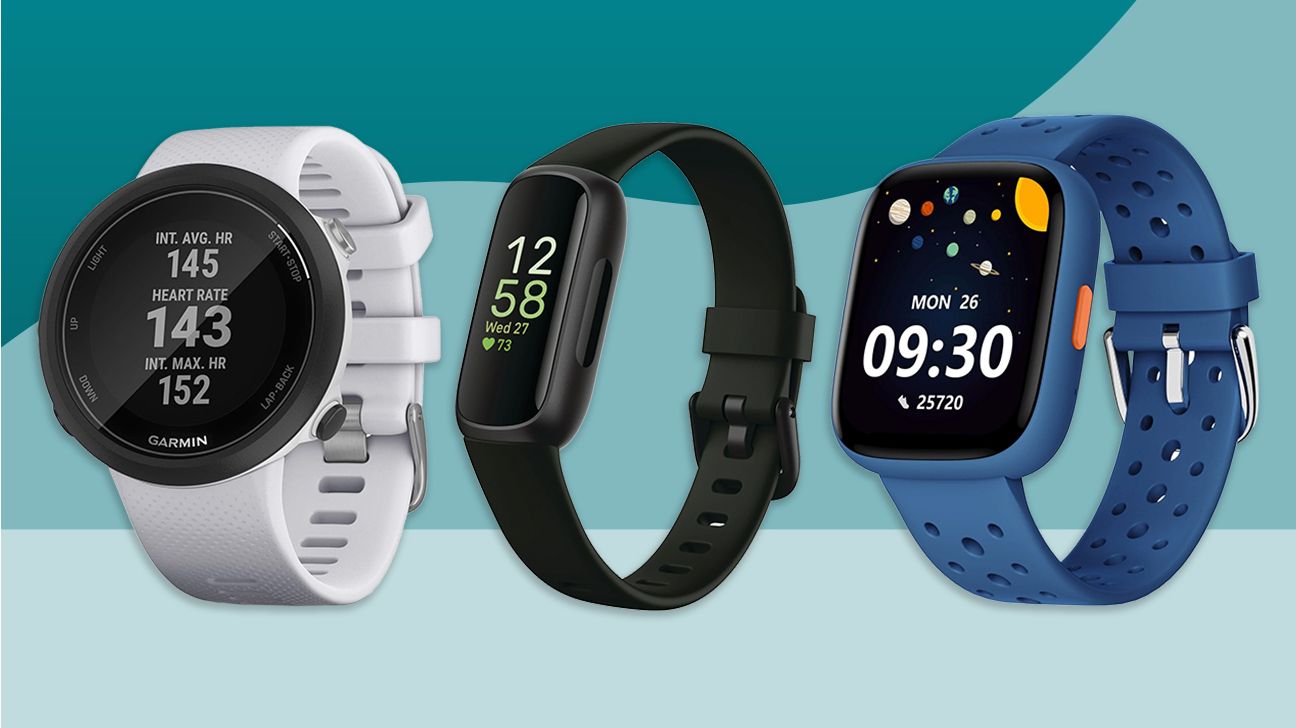
Fitness trackers not only monitor your daily activity levels but also may help you take control of your health with features like stress tracking, heart rate monitoring, and daily movement reminders. Waterproof fitness trackers mean you don’t have to go analog when counting lengths and tracking your performance, with many offering advanced swim-specific tracking to help you understand and improve your workouts.
Read on to learn about four of the best waterproof fitness trackers we believe suit a wide range of needs and budgets.
The table below compares each of the trackers in our list on their main features.
To pick our top four waterproof fitness trackers, we considered:
- Water resistance: All of the fitness trackers we featured are water resistant. We looked at IP and ATM ratings for each product.
- Health and activity tracking: We included products with a good variety of health tracking features, such as activity tracking, heart rate monitoring, sleep tracking, and more. For fitness trackers specific to swimming, we looked for options that include useful measures of swim performance, including swim duration, speed, and stroke insights.
- Price: We included waterproof fitness trackers at a range of price points.
- Customer reviews: We also considered what buyers are saying about these products and only picked those with a good reputation among customers.
There are many factors to consider when shopping for a waterproof fitness tracker.
For starters, be sure to consider which features are most important to you, such as heart rate monitoring, GPS integration, sleep tracking, or smartphone compatibility.
Keep in mind that fitness trackers also offer varying degrees of water resistance. While some may work well in the shower or rain, not all are suitable for water sports like swimming or diving.
You should also keep your budget in mind, as fitness trackers range widely in price.
Finally, consider which type of tracker you’d prefer. In addition to smartwatches, other types include goggles, rings, wristbands, chest straps, and armbands.
Understanding IP and ATM waterproof ratings
Many fitness tracker brands will use the term “waterproof” in their marketing, but it’s best to rely on IP and ATM ratings to understand exactly how well your fitness tracker will cope with water exposure.
IP ratings classify how well devices can resist dust and water. IP stands for Ingress Protection, and you may see ratings such as “IP67” or “IPX6.” The first number refers to protection from solids on a scale from 0 to 6, with six meaning a device is fully dustproof. The second number refers to protection from liquids on a scale from 0 to 9, with nine showing that a device is resistant to high-pressure hot water from different angles.
If there is an “X” in an IP rating, it means the product has not been tested in that category.
ATM ratings refer to water pressure resistance. You’ll see ratings such as 1 ATM or 20 ATM. A rating of 1 ATM means a device can withstand pressures equivalent to a depth of 10 metres. Fitness trackers for swimming should be 5 ATM or higher.
It’s important to note that real-world durability against water will depend on the water temperature, product wear, and the type of water. Check manufacturing guides to make sure you’re using your product in appropriate environments.
The benefits of wearable fitness devices are numerous.
They can also
Fitness trackers can be useful as one tool for monitoring health, but they will not result in huge changes when used alone. It is also important to pay attention to your diet, activity levels, and health conditions that may be affecting your overall well-being.
What to be aware of
Although fitness trackers have many uses and benefits, there are some risks to using them. Firstly, they may not be totally accurate when tracking certain metrics. The conditions in which you use the tracker may also affect its accuracy.
Plus, data privacy can be a concern, especially because these devices collect sensitive health data.
Research has shown that fitness trackers can lead to negative health impacts on people’s psychological well-being, potentially making symptoms of obsessive-compulsive disorder worse. Focusing on goals and competitive features may also negatively impact a person’s mental health.
Garmin Swim 2
Fitbit Inspire 3
Fitbit Inspire 3
Garmin Swim 2
There are many fitness trackers on the market, and it can be tough to narrow down which one might be best for your needs. Considering your favorite activities, the health metrics you’d like to track, and how much money you’d like to spend on a fitness tracker can help you make the right choice for your goals.