Key takeaways
- Ultomiris is administered intravenously by a healthcare professional, with infusion times varying from 24 to 90 minutes or more depending on the dose.
- The dosage of Ultomiris is determined by body weight and includes an initial higher loading dose followed by maintenance doses to sustain drug levels.
- Dosing schedules for Ultomiris differ based on the condition being treated and may require adjustments if a dose is missed.
Ultomiris (ravulizumab-cwvz) is a brand-name drug prescribed for certain inflammatory diseases.
Specifically, Ultomiris is used to treat the following conditions:
- paroxysmal nocturnal hemoglobinuria in adults and children ages 1 month and older
- atypical hemolytic uremic syndrome in adults and children ages 1 month and older
- generalized myasthenia gravis in certain adults
- neuromyelitis optica spectrum disorder in certain adults
The active ingredient in Ultomiris is ravulizumab-cwvz. It belongs to a group of drugs called complement inhibitors.
This article describes the dosages of Ultomiris, as well as its strengths and how it’s given.
This section describes the usual Ultomiris dosing schedule in adults and children.
What is the form of Ultomiris? How is it given?
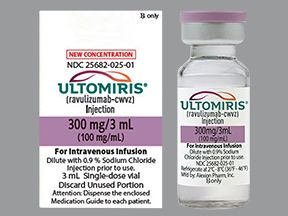
Ultomiris comes as a liquid solution that’s given as an IV infusion (an injection into a vein over a period of time). It’s always given by a healthcare professional in a doctor’s office or clinic.
The length of your infusion may depend on your specific dosage. It could take from 24 minutes to 90 minutes or longer.
Your doctor can give you more information about Ultomiris treatments. You can also visit the drug manufacturer’s website.
What strengths does Ultomiris come in?
Ultomiris comes in two sizes, both of which are the same strength:
- 300 milligrams in 3 milliliters of liquid solution (100 mg/mL)
- 1,100 mg in 11 mL (100 mg/mL)
What are the usual dosages for Ultomiris in adults?
Your Ultomiris dosage is determined by your body weight in kilograms (kg). One kg is equal to 2.2 pounds (lb). Your doctor will likely check your weight at each appointment to make sure you receive the correct dose.
Your first dose of Ultomiris will be a loading dose. This is a higher amount of drug given at the start of treatment. It helps the drug start working right away.
Your first maintenance dose will depend on your current treatment for your condition. This dose maintains a steady level of the drug in your body over time. Your doctor will give you a dosing schedule for your Ultomiris infusions. These schedules are listed in the following sections for the condition the drug is used to treat.
The following information describes dosages that are commonly used or recommended. However, your doctor will determine the best dosage to fit your needs.
Note: A supplemental dose of Ultomiris is required if a patient undergoes plasma exchange, plasmapheresis, or receives intravenous immunoglobulin (IVIg), as these treatments reduce the drug’s levels in the body.
Dosage for paroxysmal nocturnal hemoglobinuria (PNH)
You’ll start treatment for PNH by receiving one loading dose. You’ll receive your first maintenance dose 2 weeks later. Then, 4 or 8 weeks later, you’ll receive your next maintenance dose.
Here’s the typical dosing schedule for PNH:
| Body weight in kg | Ultomiris loading dose | Ultomiris maintenance dose | Ultomiris dosing schedule |
|---|---|---|---|
| 5 kg to less than 10 kg | 600 mg | 300 mg | once every 4 weeks |
| 10 kg to less than 20 kg | 600 mg | 600 mg | once every 4 weeks |
| 20 kg to less than 30 kg | 900 mg | 2,100 mg | once every 8 weeks |
| 30 kg to less than 40 kg | 1,200 mg | 2,700 mg | once every 8 weeks |
| 40 kg to less than 60 kg | 2,400 mg | 3,000 mg | once every 8 weeks |
| 60 kg to less than 100 kg | 2,700 mg | 3,300 mg | once every 8 weeks |
| 100 kg or greater | 3,000 mg | 3,600 mg | once every 8 weeks |
Dosage for atypical hemolytic uremic syndrome (aHUS)
The dosage for aHUS is the same as that for PNH. (See previous section.)
Dosage for generalized myasthenia gravis (gMG)
You’ll start treatment for gMG with one loading dose and receive your first maintenance dose 2 weeks later. Then, 8 weeks later, you’ll receive your next maintenance dose. Your Ultomiris infusions for gMG will continue once every 8 weeks.
Here’s the typical dosing schedule for gMG:
| Body weight in kg | Ultomiris loading dose | Ultomiris maintenance dose | Ultomiris dosing schedule |
|---|---|---|---|
| 40 kg to less than 60 kg | 2,400 mg | 3,000 mg | once every 8 weeks |
| 60 kg to less than 100 kg | 2,700 mg | 3,300 mg | once every 8 weeks |
| 100 kg or greater | 3,000 mg | 3,600 mg | once every 8 weeks |
Dosage for neuromyelitis optica spectrum disorder (NMOSD)
The dosing schedule for NMOSD is the same as that for gMG. (See previous section.)
What’s the dosage of Ultomiris for children?
Ultomiris is prescribed to treat PNH and aHUS in children ages 1 month and older. It’s not approved to treat gMG or NMOSD in children.
Your child’s dosage is based on their body weight. For details, see the “Dosage for PNH” and “Dosage for aHUS” sections.
If you have questions about your child receiving Ultomiris, talk with their doctor.
Is Ultomiris used long term?
Yes, Ultomiris is usually prescribed as a long-term treatment. If you and your doctor determine that it’s safe and effective for your condition, you’ll likely receive it long term.
If you miss an appointment to get an Ultomiris IV infusion, call your doctor’s office immediately. You should get your missed infusion within 7 days of when it was scheduled. Then, you’ll follow your original dosing schedule for the next dose.
If you miss an appointment and don’t get your dose within 7 days of when it was due, your doctor will adjust your future dosing schedule as needed.
Note: While the schedule can occasionally vary by 7 days, this does not apply to the first maintenance dose.
If you need help remembering your infusion appointments, try using a medication reminder.
Disclaimer: While Healthline strives for factual, comprehensive, and current information, this article is not a substitute for a licensed healthcare professional’s expertise. Always consult a doctor before taking or discontinuing any medication. Drug information is subject to change and may not cover all uses, directions, precautions, warnings, interactions, reactions, or adverse effects. The lack of a warning does not guarantee a drug’s safety, effectiveness, or appropriateness for all patients or specific uses. Learn more about our approach to content integrity.